Spiritual inquiry, and literary elegance with Priyanka Sharma Kaintura
Mahadevi, Myth and Meaning
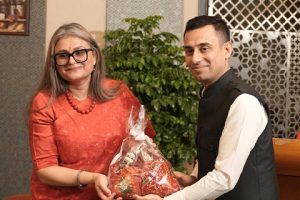
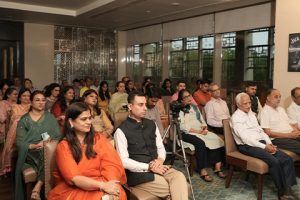
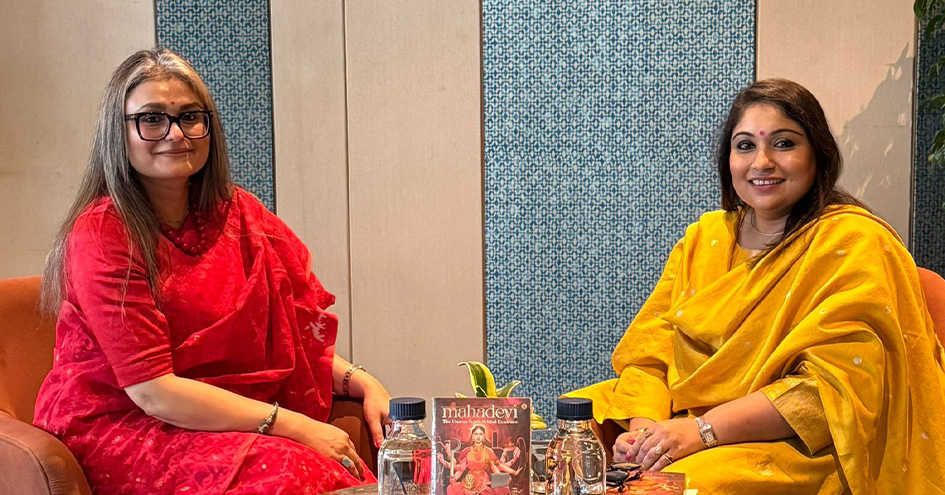
A spiritual inquiry, and literary elegance unfolded in Jodhpur during a captivating session of The Write Circle, an initiative of the Prabha Khaitan Foundation. The event brought together readers, thinkers, and seekers for an illuminating conversation featuring author Priyanka Sharma Kaintura, in conversation with Sushma Niraj Sethia, Ehsaas Woman of Jodhpur. The event commenced with a gracious welcome address by Preeti Mehta, Ehsaas Woman of Jodhpur.
The conversation commenced with Kaintura tracing the origins of her writing journey. Having spent over two decades in corporate communications, she spoke about how a life shaped by movement across cultures, geographies, and perspectives gradually nurtured a deep instinct for observation and storytelling. Writing, she revealed, had long served as a private means of making sense of the world.
The turning point arrived during the pandemic when an intense desire to understand the concept of Shakti drew her towards a deeper exploration of the Divine Feminine. She said, “I wanted to know who she is. Especially being a woman, I wanted to understand what Shakti is. Was it merely the iconography that we see with many arms, ornaments, and a lion, or was there something deeper?” This journey culminated in Mahadevi, a work that reinterprets mythological narratives through a contemporary lens while retaining their spiritual and philosophical essence.
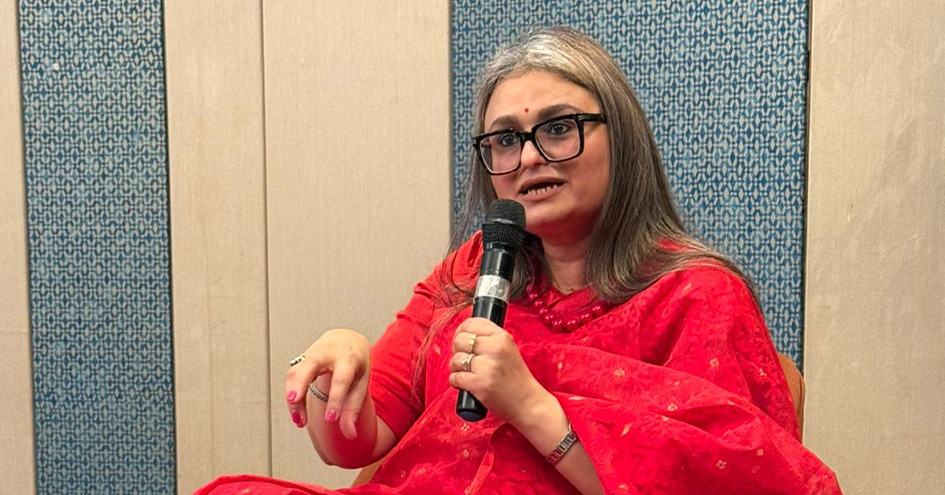
One of the most compelling segments of the discussion centred on Kaintura’s distinction between femininity and womanhood. Drawing upon various manifestations of the Goddess, she challenged the tendency to use the two terms interchangeably. “I was confused between femininity and womanhood. These are not the same things. Saraswati is feminine, sophisticated, elegant, and intellectual, but she is not defined by wifehood or motherhood. Kali is profoundly womanly, yet she is unconcerned with conventional femininity. Durga stands somewhere in between. Understanding that distinction changed everything for me.” she observed.
Using concepts such as the Fibonacci sequence, the Golden Ratio, and the Sri Yantra, she demonstrated how ancient symbols often correspond with principles that modern science continues to explore. Referencing the Goddess Lalita Tripura Sundari, she remarked upon the remarkable parallels between sacred geometry and mathematical harmony.
“Kali is dark, cannot be seen, cannot be understood, cannot be contained, and from her comes the universe,” she remarked, prompting listeners to reconsider familiar mythological imagery through an entirely new lens.“I had to ensure that people who are reading the book are able to connect with it. If I wrote something that was only Puranic, my fear was that it might not be received in the way I intended. I had to speak the language people understand today while preserving the depth of what our scriptures are trying to convey.”